
When you deploy capital into an EB-5 real estate project, the distinction between a loan-based structure and a preferred equity structure feels simple: loans sound safer, equity sounds riskier. In practice, the opposite is often true.
The real risk drivers aren’t the label; they’re the capital stack position, the developer’s financial alignment, and the incentive structure built into the investment terms. This is why BAI Capital structures its flagship projects—Archer Place and Sweetwater Place (Alma Miami)—as preferred equity. The difference in how investors are protected depends not on what the investment is called, but on who gets paid first, and why.
The Two Capital Structures: Side-by-Side
EB-5 capital flows into projects in one of two ways:
Loan-Based Model: The New Commercial Enterprise (NCE) lends investor capital to the Job Creating Entity (JCE). The investor holds a subordinated debt position—their capital must be repaid before the developer sees a dollar, but after all institutional lenders (senior and mezzanine debt).
Preferred Equity Model: The investor buys a preferred ownership stake in the project. The investor holds equity, not a loan, but with priority distribution rights over the developer’s common equity. In the repayment waterfall, preferred equity is paid after institutional debt but before the developer recovers any capital or profit.
Approximately 80% of regional center projects use loan models, which suggests they are market standard—but market standard and investor-optimal are not the same thing.
The Capital Stack: Position Determines Outcome
To understand which structure protects you, you must first map the entire capital stack.
A typical capital stack ranks like this (from first-paid to last-paid):
- Senior Debt (bank lender, ~50–75% of total capital): Secured by first mortgage; lowest risk, lowest return.
- Mezzanine Debt (optional, ~10–20%): Sits between senior and equity; moderate risk, moderate returns.
- EB-5 Capital (loan or equity model, typically 20–35%): The investor’s position—depends on structure.
- Developer Common Equity (typically 10–25%): The developer’s skin in the game; last to be paid.
The critical insight: Developer equity contribution is a meaningful indicator of alignment. When the developer contributes less than 10% of equity, this deserves additional scrutiny.
In a total project failure, institutional senior debt sits above both loan and equity EB-5 positions. If nothing remains after senior lenders are paid, no EB-5 investor is repaid—regardless of structure.
In a partial recovery (some money exists but not enough for everyone), the structure does matter. This is when your position in the waterfall determines whether you get paid or not.
In a successful exit (sale or refinance), the difference between loan and equity becomes stark.
The Loan Model: Why Alignment Breaks Down
How Loan-Based EB-5 Works
In a loan-based structure, the NCE loans investor capital to the developer’s JCE at a negotiated interest rate (typically 2–3% paid to investors). The loan has a nominal maturity—often 5 years—with optional extensions.
On paper, the maturity date forces repayment. In practice, extensions are routine. More importantly: extensions require NCE approval, yet the NCE is managed by the RC, which profits from the loan staying outstanding.
This is the core problem: the party meant to oversee investor interests is financially aligned with extending debt rather than repaying it.
The Regional Center’s Conflict of Interest
Here’s how the math creates a conflict:
Typical loan structure:
- Investor receives: 2–3% annual interest
- Developer pays RC (the NCE manager): 5–8% total
- RC spread (profit): 2–5% per year for keeping capital outstanding
The NCE manager—usually the Regional Center itself—earns an interest spread only while the loan remains outstanding. Once repaid, that spread disappears. This is a structural misalignment of incentives.
- The developer wants to extend the cheap EB-5 note rather than repay it, because refinancing or extending is cheaper than repaying at full current rates.
- The RC (which controls the approval for extensions) earns money from keeping the loan alive, not from investor repayment.
- The investor is the only party incentivized to get repaid.
When a project sells or refinances, the subordinated note can simply transfer to the new owner and extend again. The RC approval is not an independent check; it’s aligned with both parties who benefit from non-repayment.
The mezzanine loan has traditionally been one of the most common capital structures for EB-5 projects, given its size and the typical number of jobs created by a project. But common does not mean optimal for the investor.
The Preferred Equity Model: Incentive Alignment
How Equity-Based EB-5 Works
In a preferred equity structure, the investor buys a preferred ownership stake in the project. There is no fixed maturity date. Instead, capital is returned at a capital event—typically a sale or refinance of the project.
Preferred equity provides a targeted return (often expressed as an IRR or annual preferred return), but this return is only paid from project performance, not from a third-party obligation. This matters because it ties the developer’s financial success directly to returning investor capital.
In the waterfall at exit:
- Senior debt is repaid first
- Mezzanine debt (if any) is repaid next
- EB-5 preferred equity is repaid next
- Developer common equity is paid last (if anything remains)
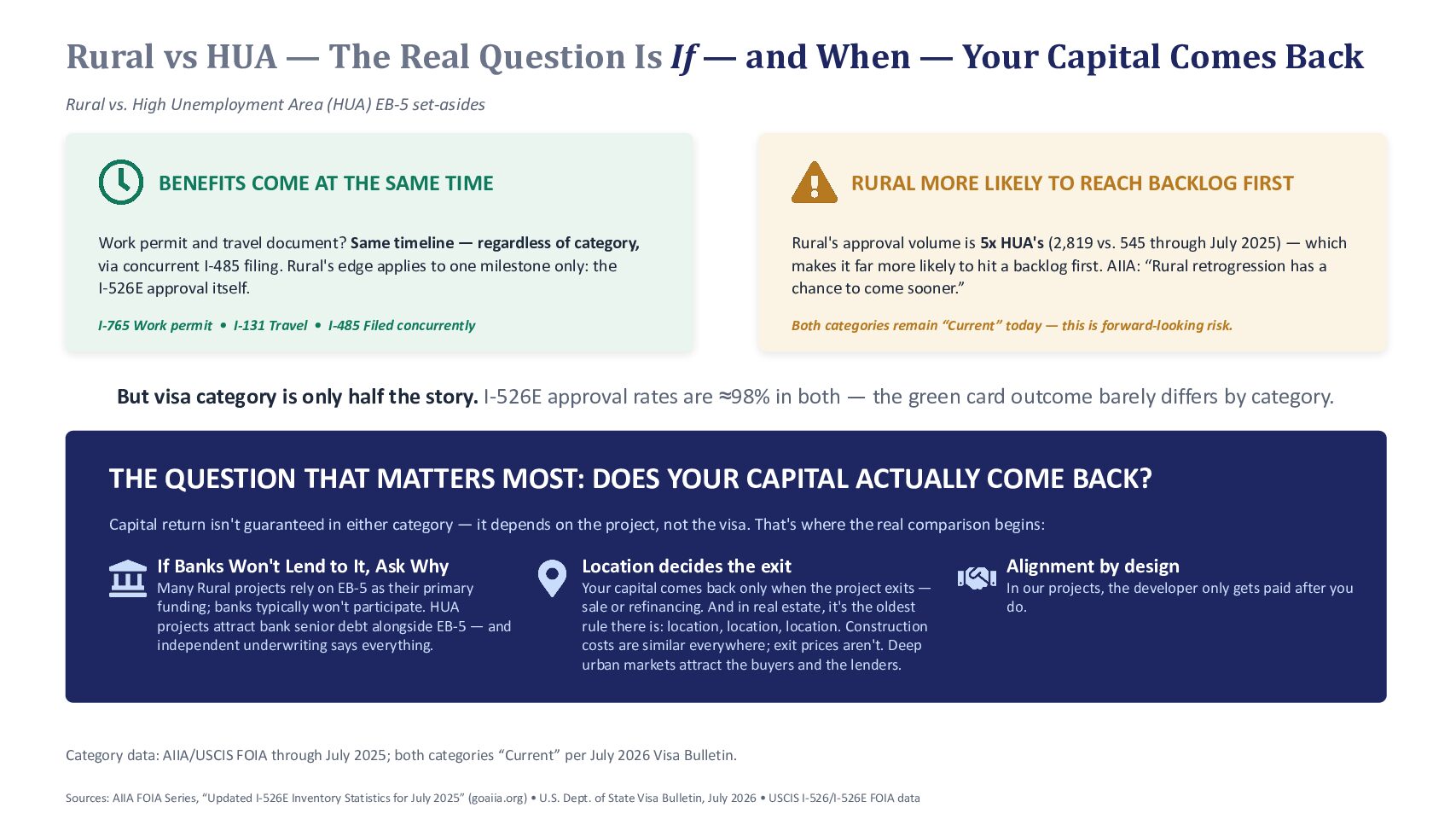
The developer cannot recover his own capital or take profit until the EB-5 investor is fully paid. This creates structural alignment: the developer only wins after the investor does.
Capital Stack Position: Why Equity Wins in Most Scenarios
Preferred equity fills a gap between the senior loan and equity component of the overall project’s capitalization. EB-5 capital is typically structured as either mezzanine debt or preferred equity, as this allows developers to leverage additional financing while keeping senior debt manageable.
In a partial recovery scenario:
- A loan investor is competing with senior lenders for limited cash, and mezzanine debt (if any) may jump the line. Capital recovery depends on how much value remains after senior lenders extract their priority.
- An equity investor is senior to developer common equity but junior to all debt. This is not “bottom of the stack”—the developer’s own money sits below you. The developer has maximal incentive to preserve capital for you before taking anything for themselves.
In a successful project:
- A loan investor receives their 2–3% annually and gets repaid at maturity (or after extension negotiations). But the developer and RC have every incentive to defer or extend. You get a fixed low return and a delayed repayment.
- An equity investor participates in project success. If the project appreciates, refinances at better terms, or sells at a premium, the preferred equity investor’s IRR compounds. The developer is rewarded for accelerating exit and maximizing value.
Real-World Application: Archer Place and ALMA Miami
Archer Place (Gainesville, FL)
BAI Capital’s Archer Place—a mixed-use, student housing, and mixed-use project in Gainesville near the University of Florida—is structured as preferred equity. This matters for two reasons:
- Job Creation Cushion: Student housing and mixed-use projects create significant direct, indirect, and induced jobs. The capital is genuinely at risk in a real estate venture, but the job-creation numbers provide a buffer. Construction delays, cost overruns, or changes in Project scope may affect both job creation and the Project’s financial performance. A preferred equity structure means the developer is maximally motivated to hit job creation targets and deliver the project on schedule.
- Developer Commitment: When a developer commits their own equity (and sits below EB-5 investors in the waterfall), they have skin in the game. You know they’re not using cheap EB-5 debt to subsidize other ventures.
The preferred equity structure ensures that capital returns depend on project success, not on refinancing games.
Sweetwater Place (Alma Miami)
Sweetwater Place (ALMA Miami)—a near-FIU, mixed-use project targeting urban Miami—is structured as preferred equity with a 4% guaranteed annual preferred return and a targeted 1.47x Multiple On Invested Capital (MOIC). This is a concrete example of how equity structures work:
- The 4% is the preferred return—a floor, paid before common equity holders see anything.
- The 1.47x MOIC means investors target recovering $1.47 for every $1.00 invested.
- Capital return timing is tied to a liquidity event (likely a refinance or sale), typically 5–7 years out, depending on project ramp.
The developer benefits only when the 4% and 1.47x are delivered to EB-5 investors first. Common equity holders (often the developer’s joint venture partner) are last. This waterfall is recorded in the operative agreements and in the partnership structure.
The project’s equity positioning means investor returns compound alongside developer upside—they rise or fall together.
The Risk Hierarchy: Total Failure, Partial Recovery, Success
Total Project Failure
In both loan and equity structures, senior institutional debt gets paid first. If the project collapses and asset sales cover only the senior loan, EB-5 investors lose capital regardless of structure.
Mitigation: Evaluate the senior lender’s conservatism. A high loan-to-cost ratio may indicate over-leverage and increased project risk. Ask for the loan-to-value (LTV) ratio and asset values. If senior debt is 85% LTV and the property drops 20% in value, there’s no margin for error.
Partial Recovery (The Critical Scenario)
Some project value exists but not enough for everyone. This is where structure saves or drowns you.
- Loan model investor: You’re subordinated to senior debt and potentially mezzanine debt. Your recovery depends on how much cash is left after senior lenders extract their priority. Mezzanine debt often sits above you. The RC has no incentive to fight for your recovery.
- Equity investor: You’re junior to all debt but senior to developer common equity. You’re first in line ahead of the developer. The developer must recover your capital before taking anything. This is where equity provides structural protection.
Successful Exit
The project is sold or refinanced. Proceeds flow according to the waterfall.
- Loan model investor: You receive your contractual interest rate and principal. You’re done. No upside participation if the project appreciates or if the exit is exceptionally profitable.
- Equity investor: Capital is returned, and you may participate in appreciation above the preferred return (depending on the terms of your equity agreement). More importantly, the developer is incentivized to maximize exit value because they only win after you do.
Key Metrics to Evaluate Capital Structure
When reviewing an EB-5 offering, ask your attorney to evaluate:
- Developer Equity Percentage: Aim for >15% developer equity. If <10%, the developer has minimal skin in the game.
- Senior Loan LTV: Lower is safer. 60–70% LTV is conservative; 80%+ is aggressive and leaves little margin for property value decline.
- Total Leverage: Senior debt + mezzanine debt + EB-5 capital as a percentage of total project cost. Higher total leverage = higher risk.
- Intercreditor Agreements: For loan-based structures, ask whether intercreditor agreements give the EB-5 lender any enforcement rights or notice rights if senior lenders face stress. For equity, confirm the waterfall is recorded.
- Repayment Timeline and Exit Strategy: Is the developer planning an exit (sale, refinance, operational cash flow)? By when? Does it seem realistic? Equity structures are only as good as the developer’s ability to execute an exit.
- RC Track Record: For loan models, research the RC’s extension practices. Do loans on their platform typically get extended? At what cost to investors? For equity, how has the RC performed on previous equity deals?
The Grandfathering Deadline: Why Timing Matters
As of September 30, 2026, EB-5 program grandfathering rules may change, affecting project sizing and job creation requirements. Both Archer Place and ALMA Miami are grandfathered projects—capital invested before September 30 will be grandfathered under current rules.
For equity investors, this deadline adds urgency to project quality, not just program timing. Equity returns compound over time; the sooner capital is deployed into a high-quality project with strong developer alignment, the sooner the exit cycle can begin.
The Bottom Line: Structure Protects Intent
For the EB-5 investor, preferred equity aligns incentives in your favor.
- The developer is paid after you.
- The RC is not simultaneously profiting from keeping your investment outstanding.
- Your returns compound with project success rather than capping at a fixed rate.
- You own a real equity stake; you’re not a subordinated lender.
Loan-based structures reward the opposite behavior: cheap debt and RC interest spreads favor keeping loans alive rather than repaying them. The 2–3% you receive annually may feel safe, but the extension risk and RC misalignment create structural headwinds.
Senior debt comes first either way. But equity is the structure where the developer only wins after you do.
What’s Your Next Move?
Before job numbers. Before IRR projections. Before immigration timelines. If you’re evaluating EB-5 investment opportunities, capital structure should be your first question.
? Archer Place | Gainesville, FL — High Unemployment Area EB-5 | Job Creation | Current Priority Dates
? Sweetwater Place (Alma Miami) | Miami, FL — High Unemployment Area EB-5 | Job Creation | Current Priority Dates
For over 16 years, BAI Capital has guided families through every stage of the EB-5 process — with a 100% green card approval rate across its prior projects. If permanent U.S. residency is on your radar, now is the time to start.
BAI Capital structures every project as preferred equity, for one reason: investor protection through alignment. Both Archer Place and ALMA Miami use this model to tie your capital return directly to developer success.
Ready to see how a preferred equity EB-5 investment fits your immigration and financial strategy?


